Accumulation Beneath the Surface
$BTC has fallen below $60K as institutional outflows and defensive options positioning continue to weigh on sentiment. Beneath the surface, however, long-term holders and patient buyers are beginning to absorb supply, hinting at the early stages of a bottoming process.


Executive Summary
- Long-Term Holders have returned to accumulation, signalling that experienced investors are once again absorbing supply during the market downturn.
- Broad-based accumulation has emerged across multiple wallet cohorts, pointing to renewed conviction as investors gradually buy into price weakness.
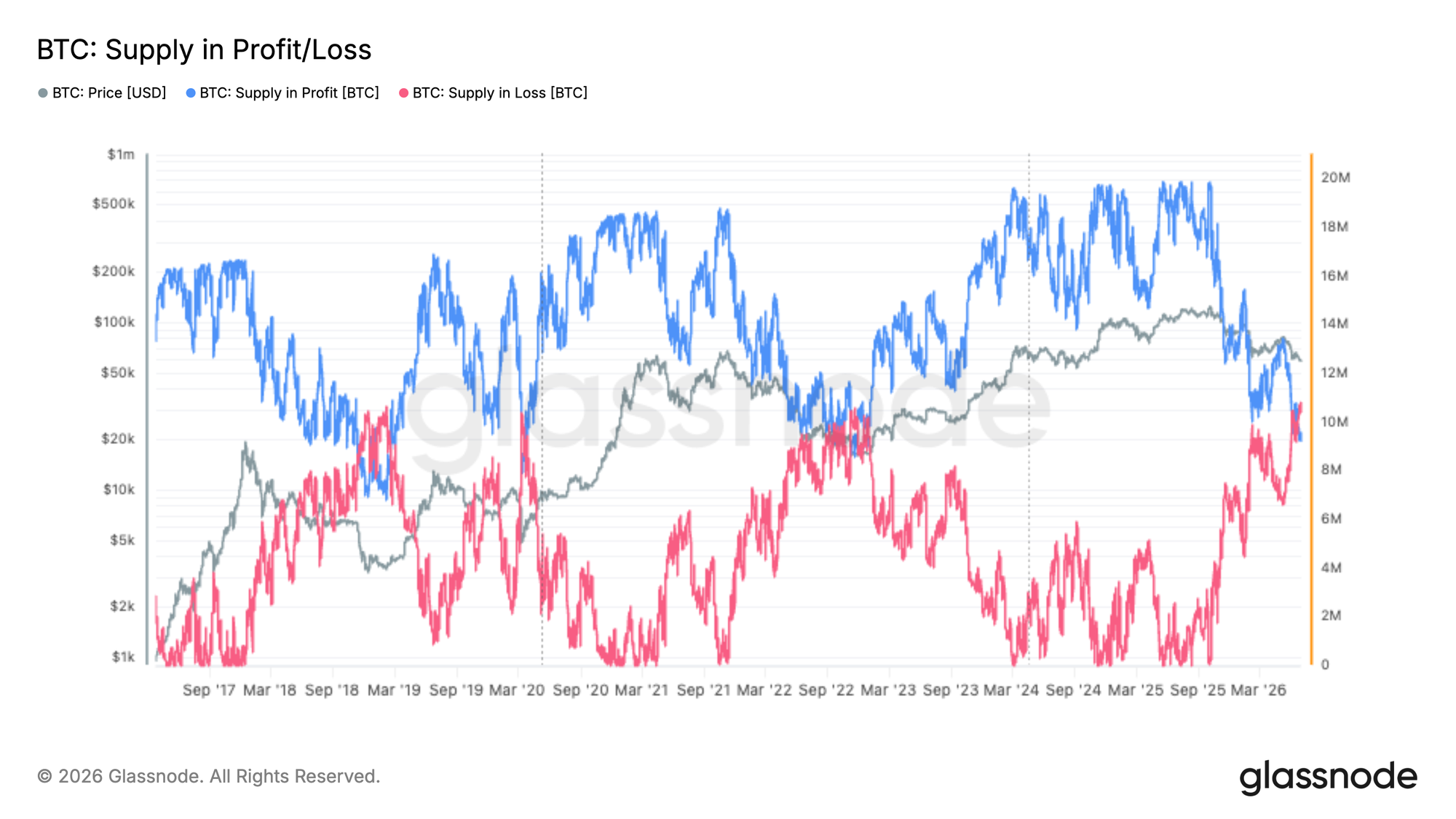
- More Bitcoin is now held at a loss than at a profit, highlighting widespread investor stress and the ongoing transfer of supply to stronger hands.
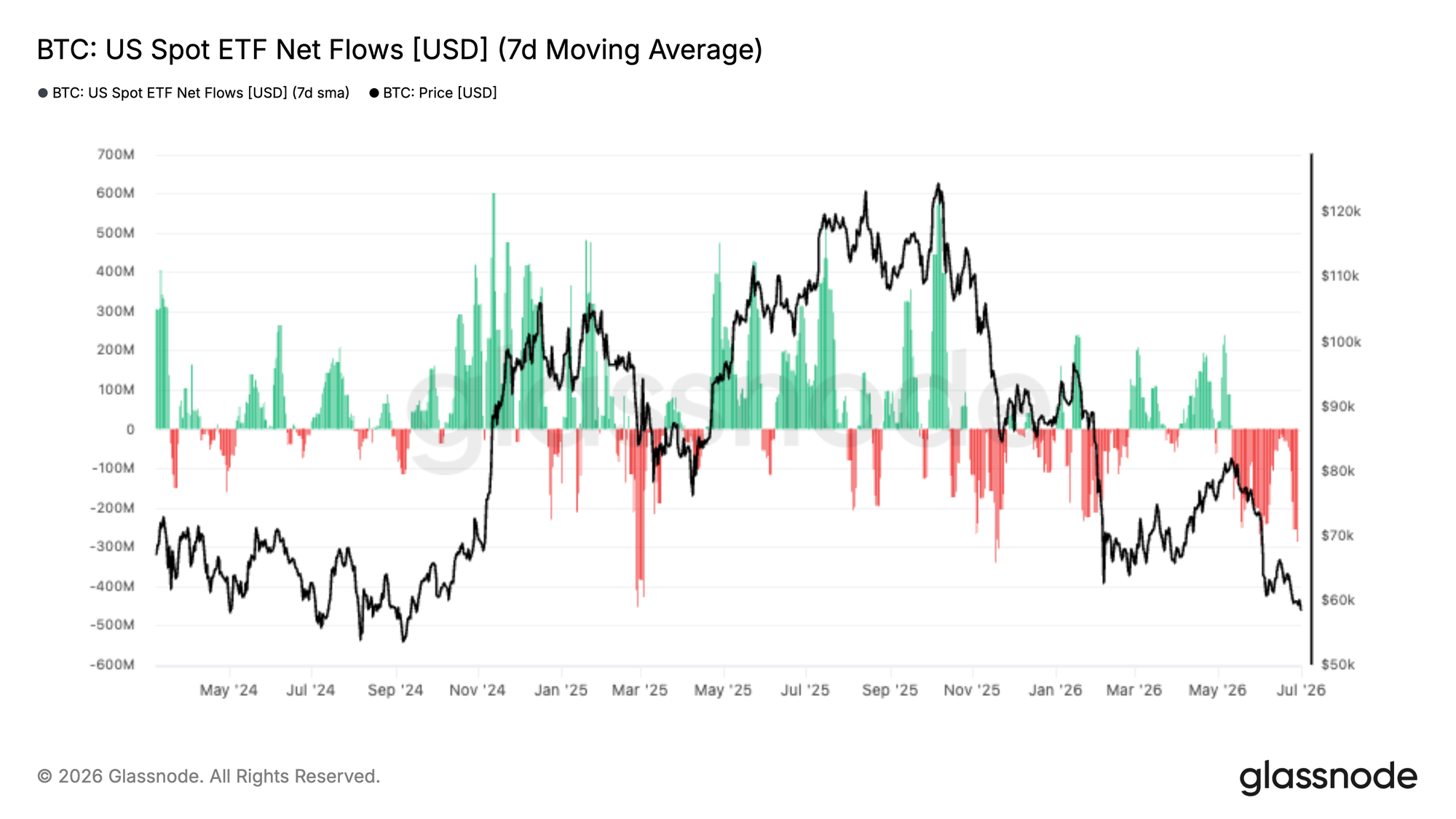
- US Spot Bitcoin ETFs remain in sustained net outflow territory, reflecting continued institutional de-risking and weakening capital inflows.
- Coinbase's orderbook has shifted heavily toward bids, suggesting institutions are patiently providing liquidity and rebuilding support beneath the market.
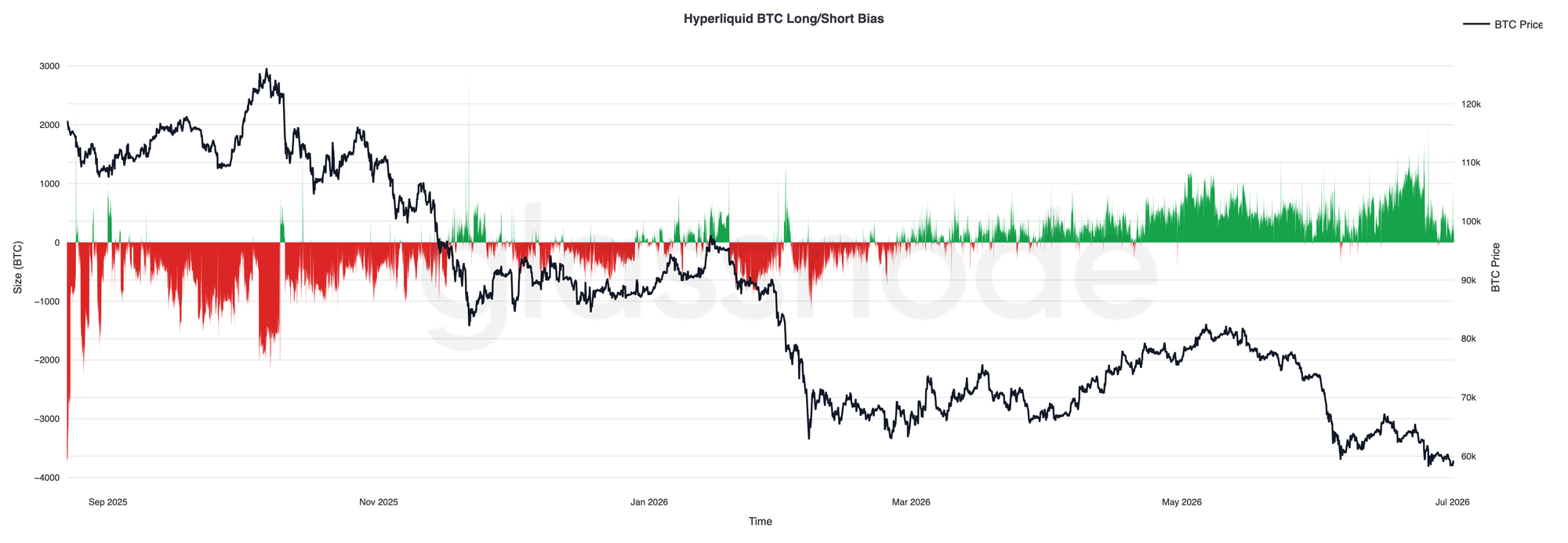
- Leveraged traders are aggressively increasing long exposure, raising the risk of either a sharp recovery or another long liquidation cascade.
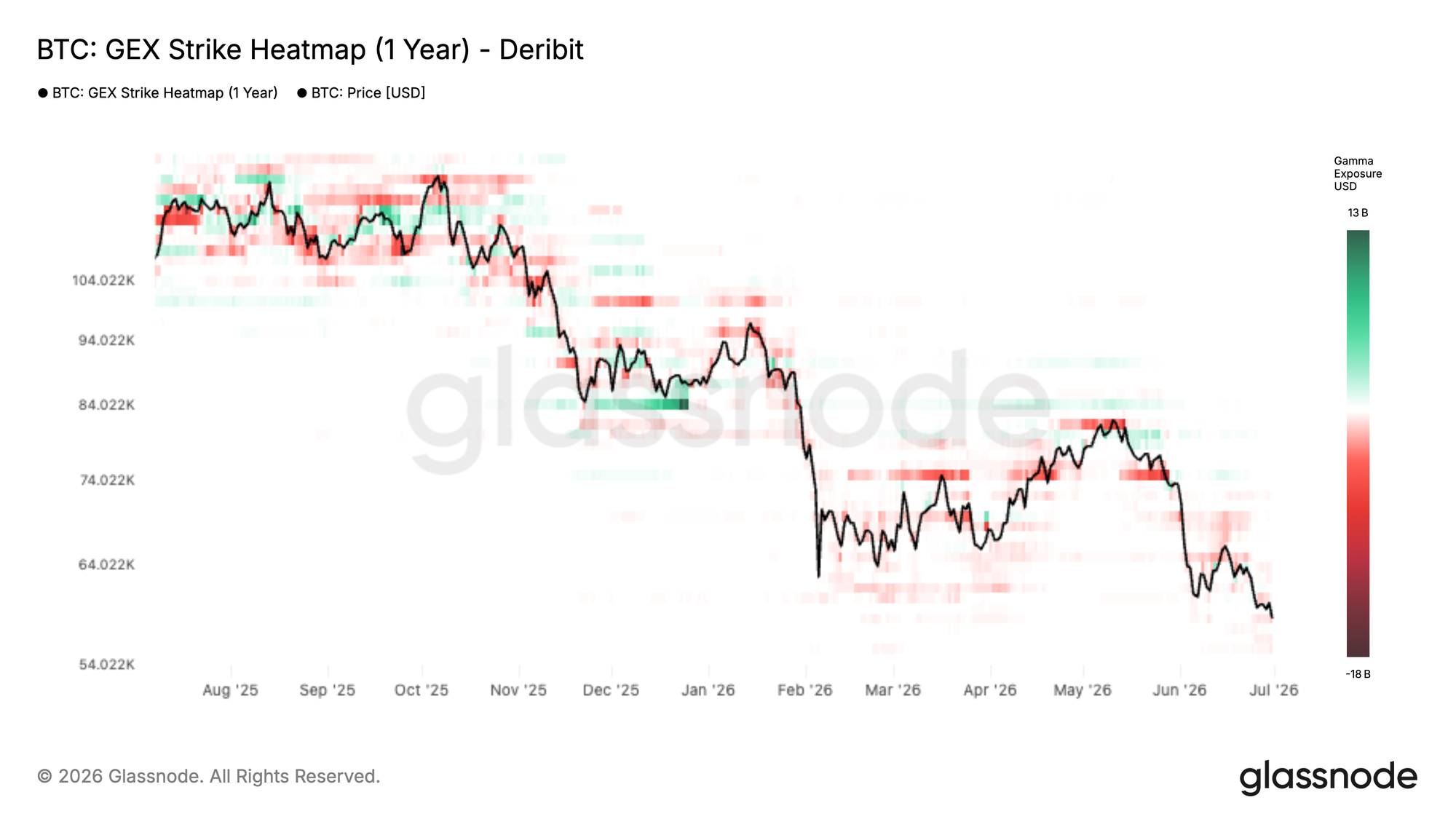
- Dealer gamma positioning has become increasingly supportive, with hedging flows likely to dampen volatility and encourage price stabilisation.
- Options traders are paying a premium for downside protection, underscoring a defensive market backdrop and elevated demand for hedges.
- Rising implied volatility suggests Bitcoin is entering a bottoming process, although one final capitulation-driven volatility spike cannot yet be ruled out.
Macro Insight
The Federal Reserve's June meeting delivered a fourth consecutive hold, but the market-moving element wasn't the decision itself. It was the tone. New Fed Chair Kevin Warsh struck a notably hawkish posture, and with inflation remaining stubbornly above target and tariff pass-through continuing to show up in consumer prices, the market has largely abandoned any expectation of cuts this year. Rate relief is now a 2027 story at the earliest. Treasury yields have drifted back toward their 2026 highs, the dollar has firmed, and the jobs market, while still adding positions, is showing signs of narrowing concentration. Financial conditions are not accommodative, and there is no near-term catalyst to make them so.
Bitcoin bore the brunt of this repricing. After a strong first quarter, June brought the sharpest institutional retrenchment since spot ETFs launched: a sustained wave of redemptions that reflected rational profit-taking rather than panic, as many institutional allocations were built at materially lower prices. The selling pressure was orderly but persistent, and it has left Bitcoin trading at levels that reset short-term expectations. The question heading into Q3 is whether macro conditions stabilize enough to restore risk appetite, or whether sticky inflation and a firming dollar continue to weigh on the assets most sensitive to liquidity expectations.
On-chain Insight
Long-Term Holders Return to Accumulation
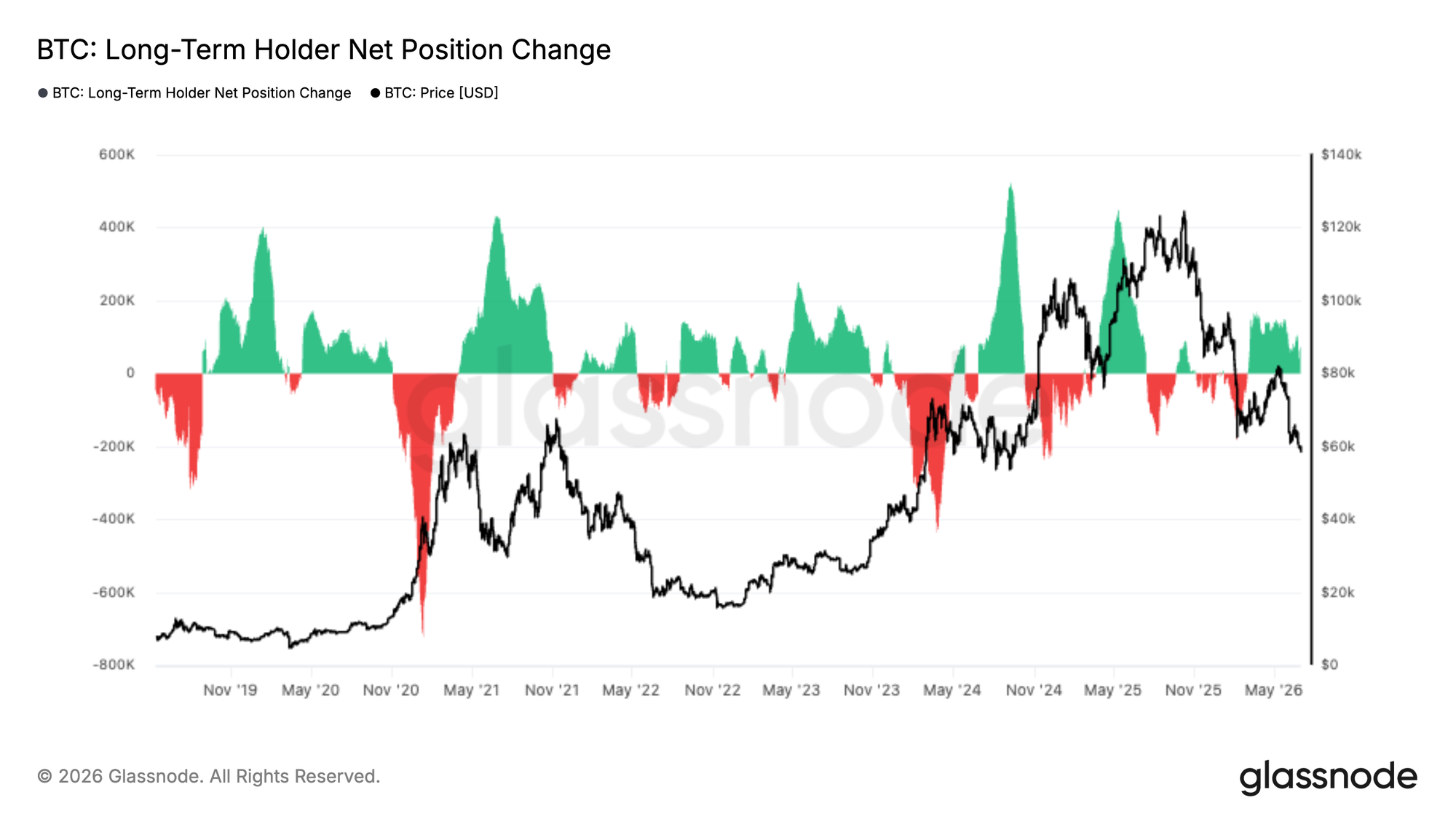
Long-Term Holders have begun rebuilding positions after an extended period of distribution, with Net Position Change firmly back in positive territory. While the pace of accumulation remains modest relative to the large buying waves seen during prior bull market expansions, it marks a notable shift in behaviour as some of Bitcoin's most conviction-driven investors once again absorb supply.
This change comes as Bitcoin has retraced toward the $60K region, suggesting experienced holders are viewing the recent correction as an opportunity rather than a reason to reduce exposure. Historically, sustained transitions from net distribution to net accumulation have often emerged during periods of market weakness, as long-term investors gradually increase their holdings while shorter-term participants de-risk. Although it is too early to call this a full accumulation regime, the return of persistent long-term buying provides an encouraging signal that conviction is beginning to rebuild beneath the surface.
Broad-Based Accumulation Emerges
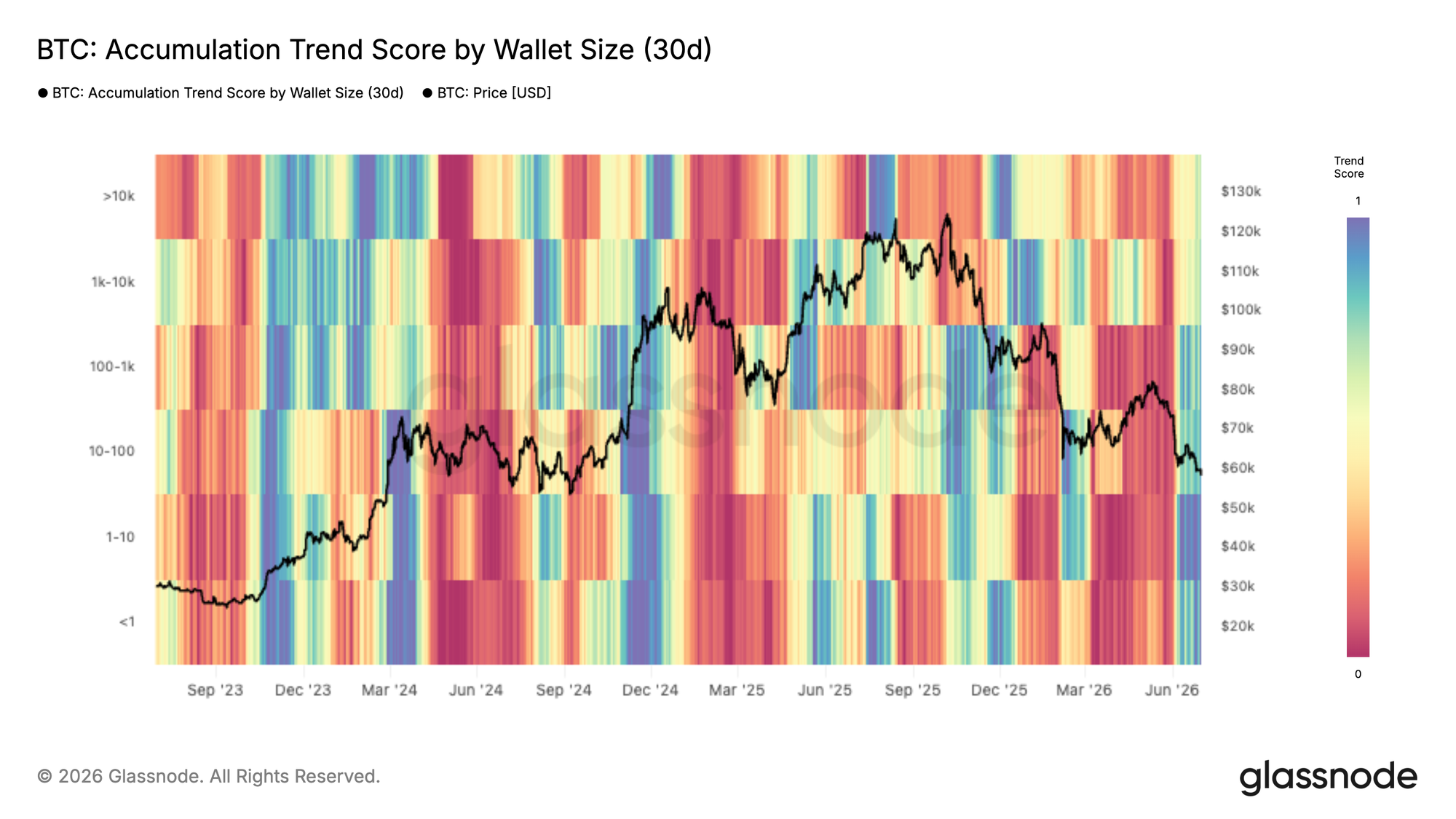
The Bitcoin Accumulation Trend Score has shifted meaningfully higher over the past month, with buying activity becoming increasingly broad-based across the investor spectrum. Following several months of persistent distribution during the market decline, most wallet cohorts have transitioned back toward accumulation, signalling that the recent correction is beginning to attract renewed demand.
The strongest accumulation is currently visible among smaller holders (<1 BTC) and entities holding between 100 and 1,000 BTC, both of which have reached near-maximum trend scores. Meanwhile, larger cohorts, including 1k–10k BTC wallets, have also turned net buyers, albeit with less intensity than earlier in the cycle. This synchronised improvement across multiple investor groups suggests confidence is rebuilding after the drawdown, with market participants increasingly willing to absorb supply near current price levels. Historically, periods where accumulation becomes widespread across wallet sizes have often provided a constructive foundation for longer-term market recoveries, although confirmation through sustained buying remains key.
Majority of Bitcoin Supply Falls Underwater
The recent sell-off has pushed the market into an important psychological and structural milestone, with more Bitcoin now held at a loss than at a profit. As of the latest data, approximately 10.83M BTC are underwater, compared to 9.22M BTC remaining in profit. This marks one of the most pronounced deteriorations in investor profitability since the current bull market began and reflects the extent of the recent repricing.
Historically, periods where loss-making supply overtakes profitable supply have coincided with elevated financial stress and widespread capitulation among newer market participants. While these environments often weigh on sentiment in the short term, they also tend to create the conditions for stronger hands to absorb coins from weaker holders. Combined with the renewed accumulation observed across Long-Term Holders and several wallet cohorts, the sharp decline in profitability suggests the market is entering a phase where supply is increasingly migrating toward investors with higher conviction.
Off-chain Insight
ETF Outflows Accelerate
Institutional demand has continued to deteriorate, with the 7-day moving average of US Spot ETF net flows falling deeper into negative territory. Following a brief recovery in inflows during May, capital has once again reversed course, with sustained outflows now accompanying Bitcoin's decline toward the $60K region. The persistence of redemptions suggests institutional investors remain in a defensive posture, reducing exposure rather than stepping in to absorb the recent weakness.
This marks a notable shift from the strong ETF-led demand that underpinned much of the previous advance. While on-chain data points to renewed accumulation among Long-Term Holders and several wallet cohorts, ETF investors have yet to display the same conviction. This divergence highlights a market currently supported by patient on-chain capital, while more price-sensitive institutional participants continue to withdraw liquidity. A stabilisation in ETF flows will likely be an important signal to watch for confirmation that broader investor confidence is beginning to recover.
Hyperliquid Traders Are Leaning Aggressively Long
Positioning on Hyperliquid has shifted decisively toward the long side, with net long exposure steadily increasing even as Bitcoin has continued to trade lower. Rather than reducing risk into weakness, leveraged traders have consistently added bullish exposure throughout the decline, pushing long bias to its highest level in the observed period.
This creates an increasingly asymmetric market structure. If buyers regain control, the large concentration of long positioning could provide fuel for a sharp recovery. However, while price remains in a clear downtrend, the build-up in leveraged longs also leaves the market vulnerable to further downside if support fails. In that scenario, forced liquidations of overextended long positions could amplify volatility and accelerate the move lower. For now, the data suggests derivatives traders are positioning for a reversal, but that conviction has yet to be validated by price.
Options Dealers Are Positioned to Dampen Volatility
The Deribit GEX Strike Heatmap suggests the options market has become increasingly dominated by positive gamma positioning around current price levels. A notable concentration of positive gamma has developed in the low-$60K region, close to where Bitcoin is currently trading. When dealers are long gamma, they typically hedge by buying into weakness and selling into strength, a dynamic that naturally dampens volatility and encourages price stabilisation around these high open-interest strikes.
This implies that, despite the recent sell-off, the options market is no longer positioned for an acceleration lower. Instead, dealer hedging flows are increasingly acting as a source of liquidity, helping absorb directional moves and reducing the likelihood of disorderly price action. That does not necessarily imply an imminent reversal, but it does suggest the market is transitioning away from the highly unstable conditions seen during the decline. Unless a significant macro catalyst forces price away from these gamma-heavy zones, options positioning points toward a period of consolidation and reduced realised volatility rather than another wave of panic selling.
Options Traders Are Paying Up for Downside Protection
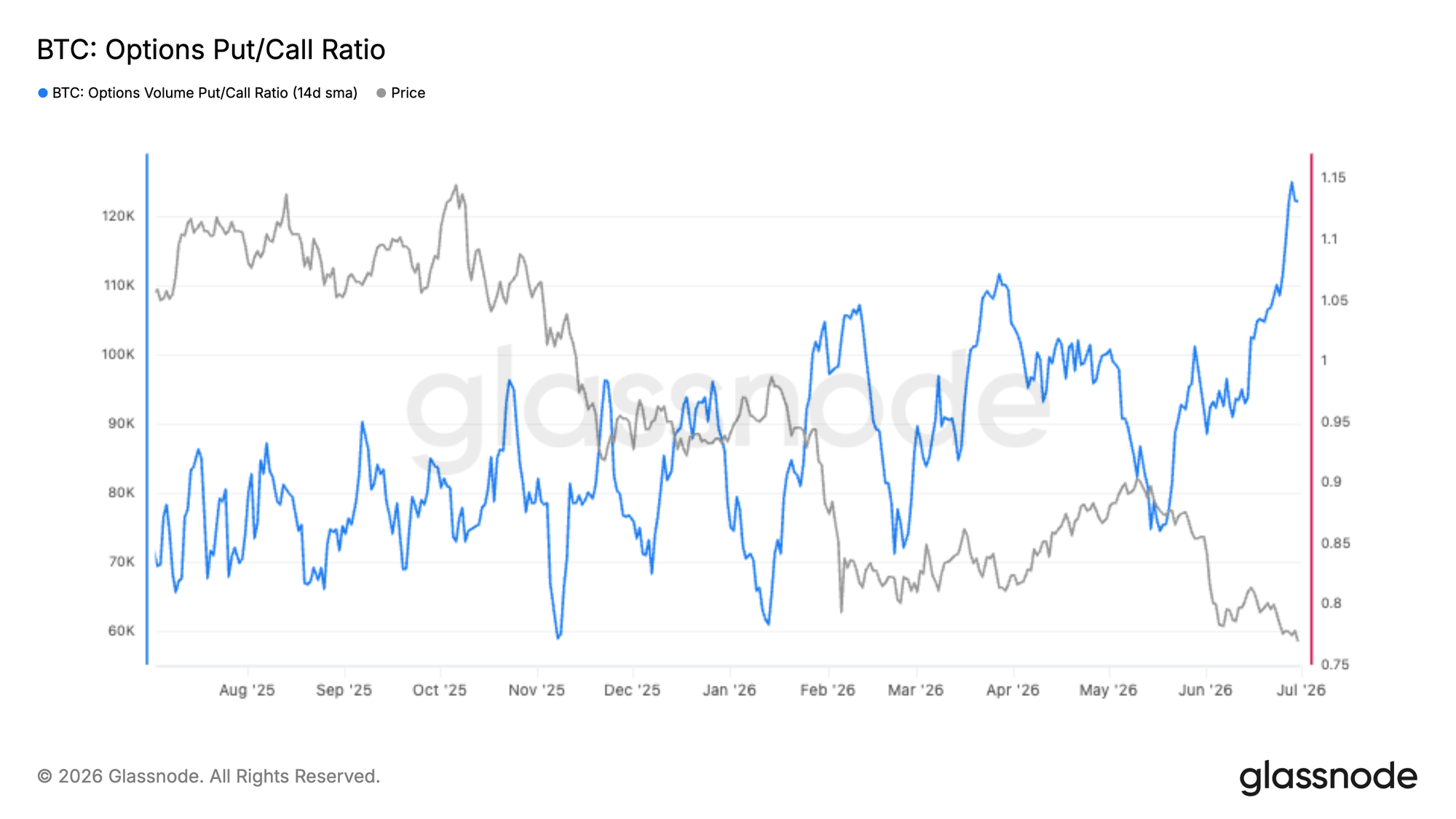
The options market has turned increasingly defensive, with the 14-day Put/Call Volume Ratio climbing sharply above 1.0 to its highest reading in the past year. This indicates that put option activity now exceeds call buying, reflecting a clear shift in positioning as traders prioritise downside protection over upside participation following Bitcoin's decline toward the $60K region.
Historically, elevated put/call ratios emerge during periods of heightened uncertainty, when investors are either hedging existing spot exposure or expressing bearish directional views. While this reinforces the cautious tone seen in ETF flows and recent price action, it can also become a contrarian signal if hedging demand becomes excessive. When a large share of market participants has already positioned defensively, the market can become less vulnerable to incremental selling pressure. For now, however, the options market continues to signal that risk management, rather than speculation on a recovery, remains the dominant priority.
Implied Volatility on the Rise
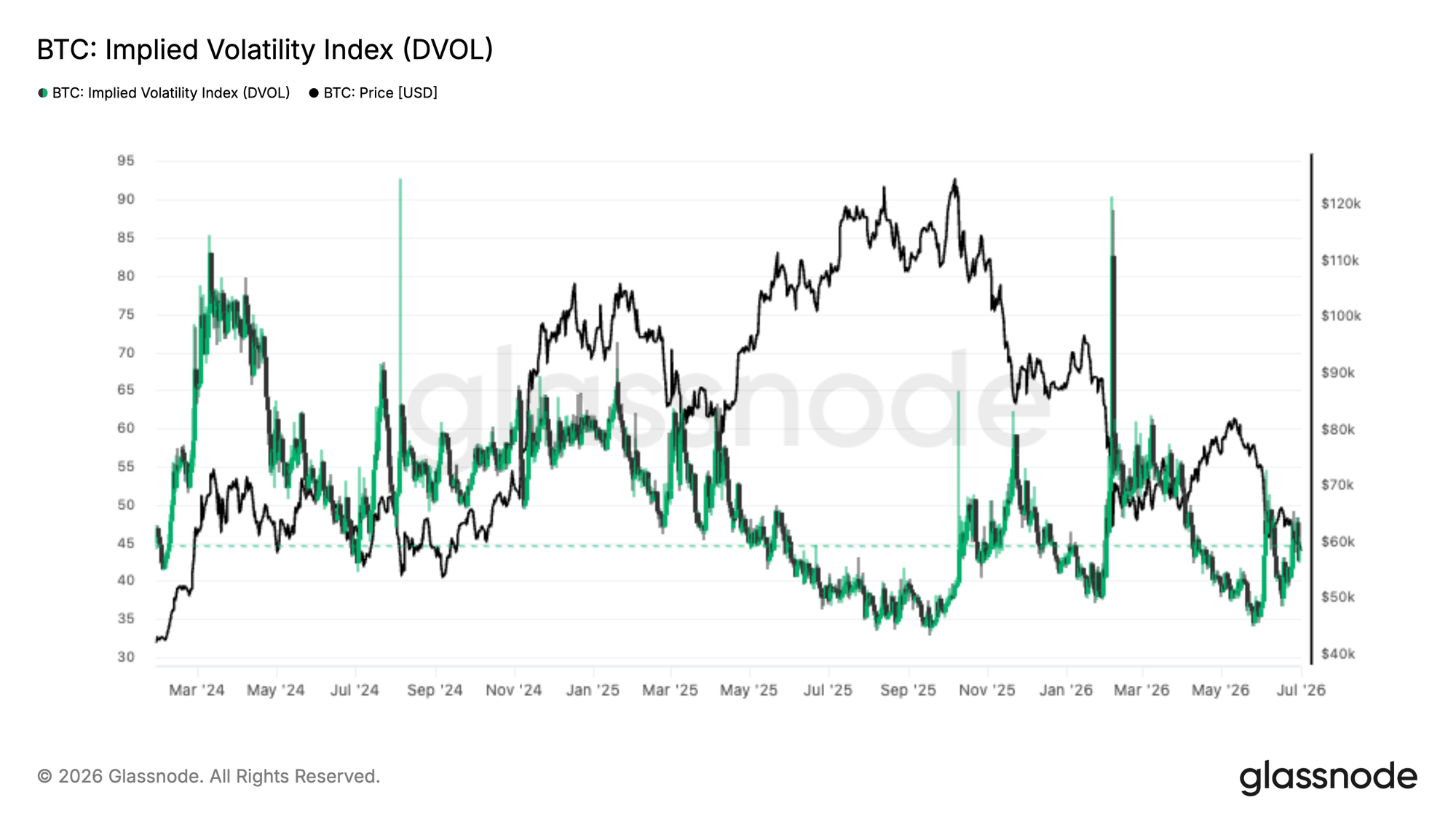
Bitcoin's Implied Volatility Index (DVOL) has begun to recover from historically depressed levels following the recent sell-off, but remains well below the panic extremes typically associated with major market dislocations. This suggests options traders are beginning to price in larger future price swings as uncertainty increases, yet expectations have not reached the levels of fear that have historically accompanied durable market lows.
From a structural perspective, this resembles the early stages of a bottoming process rather than its conclusion. Volatility has started to reprice higher as the market searches for a floor, but previous cycle lows have often been characterised by one final volatility spike as forced selling, liquidations, or a macro shock trigger a capitulation event. Should such a spike emerge, it would likely coincide with a period of indiscriminate selling and heightened stress across derivatives markets. Until then, the gradual rise in implied volatility suggests traders are increasingly preparing for a larger move, even if the ultimate washout required to establish a durable bottom has yet to materialise.
Conclusion
Bitcoin remains firmly in a corrective phase, but beneath the weak price action, several important structural shifts are beginning to emerge. Long-Term Holders are accumulating once again, buying activity has broadened across wallet cohorts, and spot orderbooks on both Binance and Coinbase are becoming increasingly bid-heavy. These are the types of changes typically associated with patient capital stepping in as weaker hands exit the market.
At the same time, caution remains warranted. Institutional capital continues to leave US Spot ETFs, options traders are aggressively hedging downside risk, and leveraged long positioning has reached elevated levels, leaving the market vulnerable to another liquidation-driven sell-off. Implied volatility also points to a market that may still require one final washout before a durable low is established.
Taken together, the data suggests Bitcoin is transitioning from a distribution phase toward one of accumulation, but confirmation is still needed. While the foundations for a longer-term recovery are gradually taking shape, the market may first need to endure one final test of conviction before a sustainable uptrend can emerge.
